The house
Two stories, five front bays, twin chimneys, a central hall, and the balanced restraint of Greek Revival design.
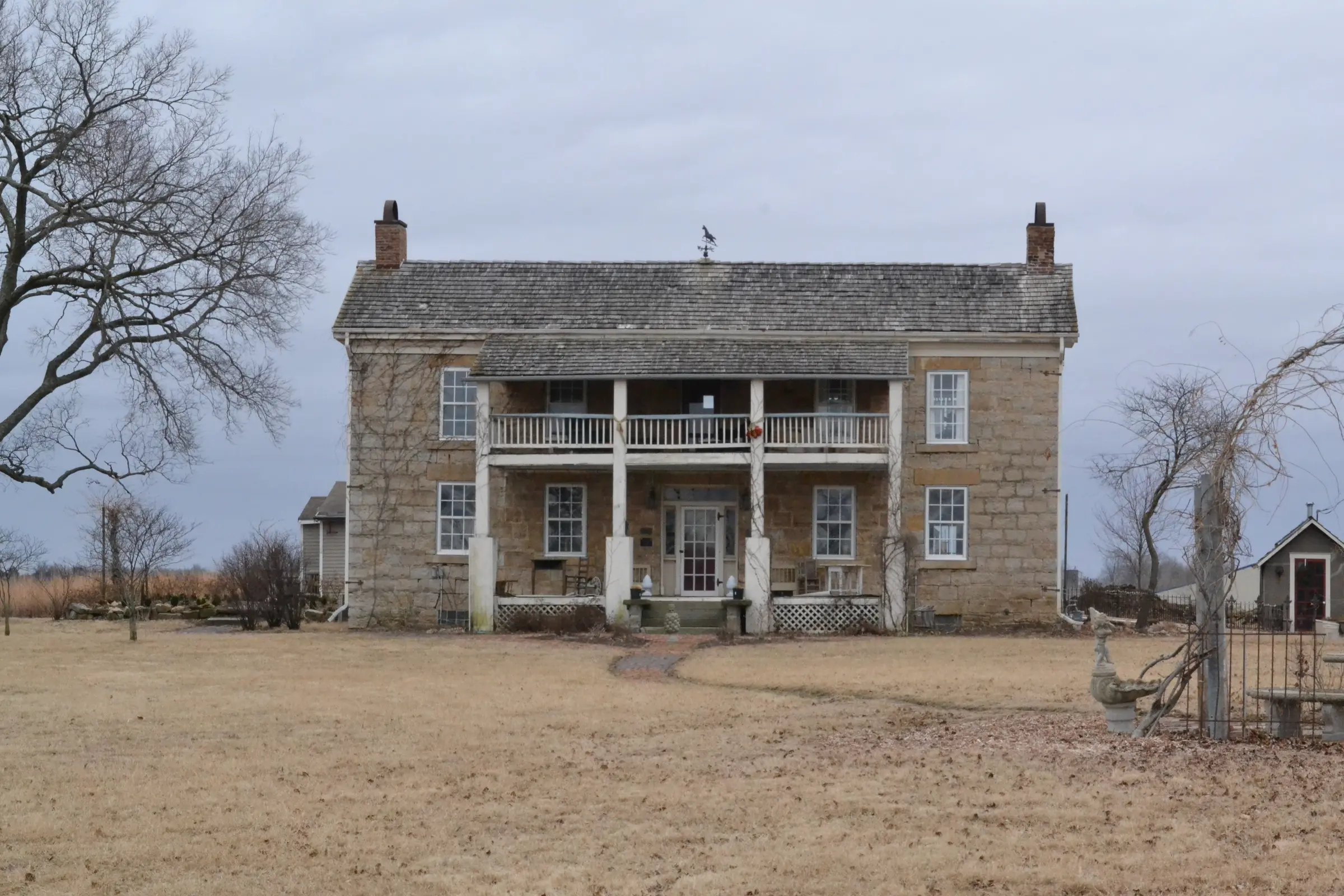
Eli Hopkins House · Tecumseh, Kansas
Begun in 1854 along the route of the Oregon Trail, this rare limestone home carries the complicated story of Territorial Kansas, settlement, slavery, war, and survival.
Photo: Ammodramus / Wikimedia Commons, CC0
The story
01The Old Stone House is a Territorial Kansas farmstead where national questions became daily life.
The farmstead began in 1854 as Eli and Susan Hopkins came to Kansas Territory from the Upper South. Construction of the large Greek Revival limestone house and substantial bank barn unfolded as nearby Tecumseh aligned with the proslavery side of the fight over whether Kansas would enter the Union free or slave.
The house later stood beside the Victory Highway, constructed over the Oregon Trail corridor between Topeka and Lawrence. It remains one of the clearest physical links between migration west, Bleeding Kansas, and the Civil War era in Shawnee County.
The place
02Oral tradition holds that the limestone was quarried where the barn now stands. Hand-dressed blocks form walls roughly eighteen inches thick; polished walnut was reportedly brought from Fort Leavenworth for the interior.
Two stories, five front bays, twin chimneys, a central hall, and the balanced restraint of Greek Revival design.
A rare surviving agricultural structure tied to the farmstead’s beginnings in 1854, built for wagon access and working-farm life.
U.S. Highway 40 follows the historic Oregon Trail route that carried emigrants between the Kansas River towns.
A working chronology
03Eli Hopkins is present as Kansas Territory opens to settlement. The farmstead and construction begin.
At the end of the year, a punishing winter tests settlers, livestock, and the agricultural systems required to survive on the open prairie.
Kansas enters the Union as a free state amid the conflict that became known as Bleeding Kansas.
The Hopkins’ daughter Susan and her husband, Nesbitt Elmore, make the house their home.
A century remains to be recovered. The property’s owners, uses, alterations, and caretakers during these years form an open chapter of research.
Preservation awards recognize the work of keeping the property and its stories alive.
The Hopkins House is listed in the National Register of Historic Places.
A preservation initiative is forming to document the site, strengthen its future, and make its stories easier to find.
Our goal is to
The next chapter should unite preservation, rigorous historical research, and careful public access—without asking a private historic property to become something it cannot sustain.
Condition assessment, measured photography, records inventory, oral histories, and an owner-approved preservation scope.
Prioritize water, masonry, roof, structure, fire safety, and other work that protects the historic fabric first.
Build a sourced public history across the Oregon Trail, Territorial Kansas, enslavement, family life, agriculture, and preservation.
Create responsible visits, school partnerships, digital exhibits, events, and a clear way for supporters to contribute.
Find the house
Please note
The site historically operated as a bed-and-breakfast but is no longer operating as such. Current booking, touring, event, and public-access information can be requested by emailing initiative@SaveTheOldStoneHouse.com. Please do not arrive without a confirmed appointment.
Access by appointment only
Read the record
The working preservation goal
Current known estimates total $190,000. The full effort must also account for professional assessment, contingency, preservation planning, safety, interpretation, repairs as they emerge while the work proceeds, and the future operation and conservation of the site. Our initial working goal is $250,000.
Start a conversation